Files and Documents Tracking Software - RFID & Barcode/QRCode
The GOBO File Tracker is a secure and scalable platform to track, monitor & manage physical Files,
Documents
& Archives. It is a comprehensive File and Document Tracking
System designed to help organizations digitally manage, monitor, and locate physical
files, documents and archives across multiple departments and locations. By leveraging advanced
RFID and
Barcode/QRCode tracking technologies, the solution provides real-time visibility into item
movement,
ownership, and status—ensuring complete control over critical records at every stage of their lifecycle.
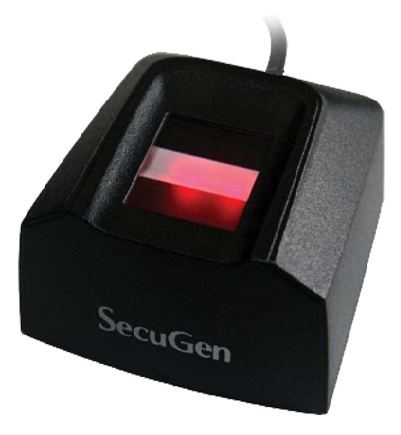
The system enables secure check-in and check-out processes using Biometric Authentication and
Digital Signature methods. System also incorporates RFID portal-based tracking that instantly
detects unauthorized
movement or missing files. Built-in chain of custody management, tamper-proof audit
trails, and role-based access controls help organizations meet regulatory, legal, and compliance
requirements while significantly reducing the risk of lost, misplaced, or mishandled documents.
Ideal for government departments, legal firms, banking and financial services, healthcare
organizations, and large enterprises, the File & Document Tracking Solution supports
end-to-end
file/document/archive lifecycle management-from creation and storage to retrieval, transfer, and
archival. With
centralized dashboards, detailed reporting, and analytics, organizations can improve operational efficiency,
enhance accountability, strengthen data governance, and ensure audit readiness while maintaining the highest
standards of security and compliance.
It ensures real-time visibility, accountability, and auditability of files, documents and archives.

File Tracker Highlights & Capabilities
Advanced Metadata Management for Files, Documents & Archives
GOBO File Tracker delivers robust management of a centralized Files, Documents, and
Archives database, serving as a single source of truth for all controlled
information
assets across the organization. The system maintains a complete and authoritative record of
every
file, document, and archive—ensuring consistency, visibility, and control throughout its entire
lifecycle.
The database captures complete item identity, detailed metadata, and lifecycle
information
through configurable, template-driven data models. These templates allow each organization to
define
exactly what information must be recorded based on internal policies, regulatory requirements,
and
operational workflows—without the need for custom development.
Configurable data fields may include, but are not limited to:
file/document/archive identification number, title or name, category or classification,
volume
number, folder type, storage location, archival date, retention period, destruction or review
date, and other organization-specific attributes. This flexibility ensures that all
critical
information is consistently captured and maintained in a structured format.
GOBO File Tracker supports flexible data entry options to accommodate both daily
operations
and large-scale data onboarding. Users can enter and update records through an intuitive
web-based
interface, while bulk upload capabilities enable rapid migration from existing spreadsheets or
legacy systems, significantly reducing manual effort and transition time.
This structured, template-driven approach ensures standardized records across
departments,
improves data accuracy, and enables fast searching, filtering, and reporting. It also provides a
strong foundation for secure file issuance and return processes, audit readiness, retention
and
disposal management, compliance monitoring, and complete end-to-end traceability of files,
documents, and archives throughout their lifecycle.
Files, Documents & Archives Tracking Using RFID Technology
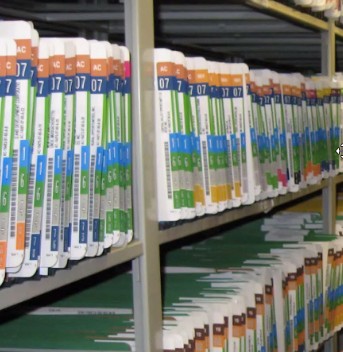
In an RFID-enabled File, Document, and Archive Tracking system, each physical file,
document
folder, or archive box is uniquely labeled with an RFID tag or RFID label and Barcode
label.
Barcode labels
may be simple black-and-white or color-coded, depending on client preferences and internal
classification standards. RFID tagging enables rapid, non-line-of-sight scanning of multiple
items
simultaneously, significantly speeding up file check-in and check-out operations while
eliminating manual entry errors.
By leveraging RFID technology, organizations can perform instant inventory audits,
quickly
locate misplaced or missing files, and maintain real-time visibility of physical records across
record rooms and storage areas. Bulk scanning with handheld readers or RFID portals allows
hundreds
of files to be identified within seconds, improving operational efficiency, strengthening
accountability, and ensuring complete traceability of files, documents, and archives throughout
their lifecycle.
RFID Enabled File Circulation and Tracking
RFID-enabled File Circulation and Tracking provide continuous, automated tracking
of physical files, documents, and archive boxes as they move across offices, record rooms, and
secure storage areas. In this model, RFID-enabled doorways and RFID-secured doors are
installed at critical transition points such as record rooms, archives, departments, and
exit/entry points. Whenever a tagged file or document passes through these doorways or doors,
the system automatically detects and records the movement without requiring manual scanning or
user intervention.
Each movement event is captured in real time, with the system updating the exact location and
custody status of the file in the centralized database. This creates a clear,
time-stamped path of travel for every file, document, or archive—showing where it
originated, which areas it passed through, and its current location. These automated logs form a
reliable audit trail that supports compliance requirements, internal controls, and external
inspections.
By providing real-time visibility and accurate location tracking, RFID-enabled
circulation workflows make it easy to locate files instantly, identify misplaced or unauthorized
movements, and respond quickly to audit or operational requests. Automated tracking eliminates
manual register entries, reduces human error, and significantly cuts down the time and effort
spent searching for documents.
Overall, RFID-enabled doorway and door-based tracking improves accountability, security, and
operational efficiency, while saving time, money, and administrative resources. It ensures
complete traceability of physical files throughout their lifecycle, strengthens records
governance, and enables organizations to manage large volumes of documents and archives with
confidence and control.

Quick Inventory, Audit & Locate
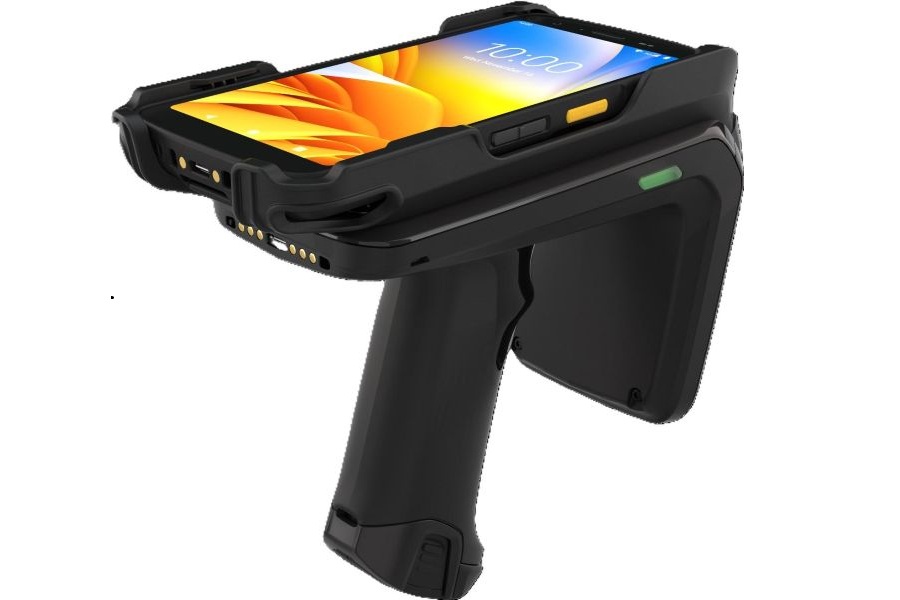
In a physical file tracking environment, RFID handheld scanners enable fast, accurate,
and efficient inventory and audit operations for files, documents, and archive boxes. By
scanning RFID-tagged items in bulk, users can instantly capture the presence and current
location of hundreds of files within seconds—without opening folders or manually checking
labels. Each inventory scan automatically updates the system with the latest location and
status of files, documents, and archives, ensuring the database always reflects real-world
conditions.
RFID handheld scanners also support comprehensive audit and verification processes.
During audits, the system can quickly identify files that are missing, misplaced, or present in
unauthorized locations by comparing expected records with actual scan results. This
significantly reduces audit time while improving accuracy and compliance with records management
policies.
In addition, handheld RFID scanners assist in rapid recovery of misplaced or missing
files. Users can search for a specific file or document and receive real-time proximity
feedback from the scanner, allowing them to locate items quickly within shelves, cabinets, or
storage rooms. This capability eliminates time-consuming manual searches and minimizes
operational disruption.
Overall, RFID-enabled handheld scanning transforms traditional file tracking into a
real-time, automated, and highly efficient process. By reducing manual effort, preventing
file loss, and accelerating inventory and audit activities, RFID enablement saves substantial
time, operational costs, and administrative resources while improving accountability and control
over physical files and archives.
Delivery & Pickup Requests Management
The GOBO File Tracker Queue Management feature
streamlines and controls the end-to-end circulation of physical files and documents across
departments. It replaces informal requests, emails, and manual follow-ups with a structured,
transparent, and auditable workflow that ensures timely file delivery and return.
The system operates through clearly defined queues, starting with the Request Queue. Users
submit requests for specific files or documents through the system, specifying purpose, priority,
and required duration. All requests are centrally visible to records staff or file custodians,
enabling efficient planning, prioritization, and controlled issuance of files based on
authorization and availability.
Once a requested file is delivered to the user's desk and work is completed, the user raises a
Ready for Pickup Queue request. This signals that the file is no longer required and can be
collected by records staff for return to the record room, transfer to another requester, or
movement to archival storage. This eliminates delays, reduces unnecessary file retention at desks,
and ensures continuous circulation without manual follow-ups.
Throughout the process, the system maintains a complete audit trail of each request,
delivery, handover, and pickup, including user identity, timestamps, and file status changes.
Queue-based workflows improve accountability, prevent file loss, and provide real-time visibility
into where files are, who is using them, and which requests are pending.
By formalizing file circulation through request and pickup queues, Queue Management improves
operational efficiency, reduces turnaround time, enhances compliance with records governance
policies, and ensures that physical files and documents are always tracked, controlled, and
available when needed.
Preventing Unauthorized Exit of Files, Documents & Archives Using RFID-Enabled Doors and Hallways
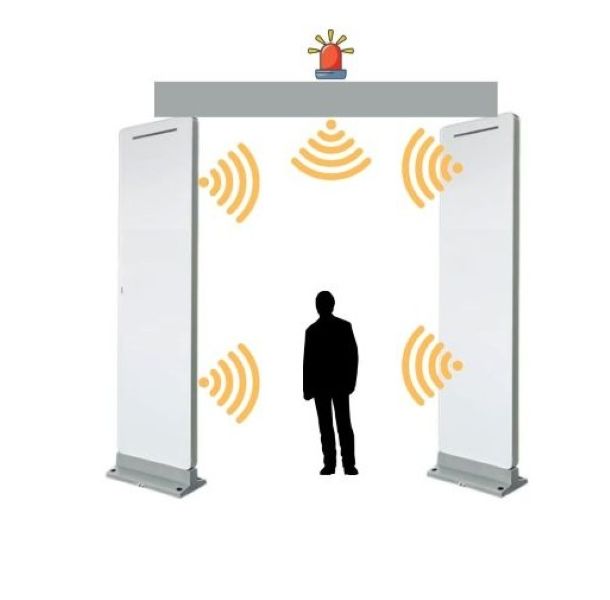
RFID-enabled doors and hallways provide an automated and highly effective mechanism to
prevent the unauthorized or unintended removal of physical files, documents, and archive boxes
from secure areas. In this setup, all files and documents are tagged with RFID labels, and RFID
readers with antennas are installed at strategic exit points such as record room doors,
department entrances, hallways, and building exits.
Whenever a tagged file or document passes through an RFID-enabled door or hallway, the system
automatically detects the movement in real time. The detected movement is immediately validated
against authorized circulation rules, including approved requests, user permissions, file
status, and destination. If a file is moved without a valid request, approval, or checkout
transaction, the system can instantly flag the event as unauthorized or unintended
movement.
Based on configured security policies, the system can trigger real-time alerts, visual
indicators, or audible alarms, and log the event for further investigation. At the same
time, the system records the exact time, location, and direction of movement, creating a
tamper-proof audit trail that clearly shows how and where the file attempted to exit.
RFID-enabled hallways extend this protection beyond single doorways by continuously monitoring
file movement across shared corridors and transition zones. This ensures that files cannot be
accidentally carried outside controlled areas, misplaced during transit, or removed without
detection—significantly reducing the risk of loss, theft, or data leakage.
By automating exit control and movement verification, RFID-enabled doors and hallways strengthen
records security, compliance, and chain-of-custody enforcement. They eliminate reliance
on manual checks, reduce human error, and provide organizations with confidence that
sensitive files and documents remain protected at all times, even in high-traffic
environments.
Compliance and Security
The system implements strong biometric authentication combined with a centralized role-based
access control (RBAC) framework to deliver secure, policy-driven, and fully auditable
access to file, document, and archive management functions. Biometric identity
verification
ensures that system access is restricted to authenticated individuals only, eliminating shared
credentials and significantly reducing the risk of unauthorized access—an essential requirement
for
compliance with ISO 27001 information security controls and internal records governance
policies.
A comprehensive RBAC model enforces access permissions based on defined roles,
responsibilities,
and clearance levels, ensuring that sensitive, classified, or restricted documents are
accessible strictly on a need-to-know basis. This structured access control supports compliance
with
ISO 15489 records management standards, data confidentiality mandates, and regulatory
requirements governing document classification, retention, and disclosure.
All file issuance, access, circulation, and return workflows are tightly integrated with
authentication and authorization controls. Every transaction requires real-time biometric
verification and role validation, and is automatically recorded with user identity, timestamp,
and
action details. This creates a complete, tamper-evident audit trail that supports
internal
audits, external inspections, and regulatory reviews.
By enforcing controlled access, maintaining immutable access logs, and aligning workflows with
defined records retention and disposition policies, the system strengthens
chain-of-custody management, reduces the risk of file loss or unauthorized disclosure,
and
ensures long-term compliance. The combined use of biometric authentication, granular RBAC, and
audit
logging delivers a standards-aligned, compliance-ready access control framework suitable
for
government records offices, courts, law enforcement agencies, regulated enterprises, and
high-security archival environments.
Single Sign On (SSO)
GOBO File Tracker seamlessly integrates with Microsoft Entra ID (Azure AD) and other industry-standard identity providers to enable secure Single Sign-On (SSO). This integration allows personnel authentication and role-based access rights to be centrally managed by the organization's IT or security team. By enforcing unified identity governance, the system ensures only authorized personnel can access files, documents and archives, strengthens security controls, and helps organizations maintain regulatory and organizational compliance across all locations.
Deployment Options
GOBO File Tracker offers flexible deployment options to align with an organization's IT strategy and security requirements. The system can be deployed on on-premises infrastructure, on client-owned private cloud environments, or on public cloud platforms such as AWS, Microsoft Azure, or other leading cloud providers. This flexibility allows organizations to choose a deployment model that best fits their operational, regulatory, and data-sovereignty needs. Deployment decisions are guided by the client's internal IT governance and security policies, and GOBO strictly adheres to established cybersecurity standards, access controls, and compliance requirements to ensure secure and reliable system operations across all environments.
Additional Key Features:
Status Monitoring
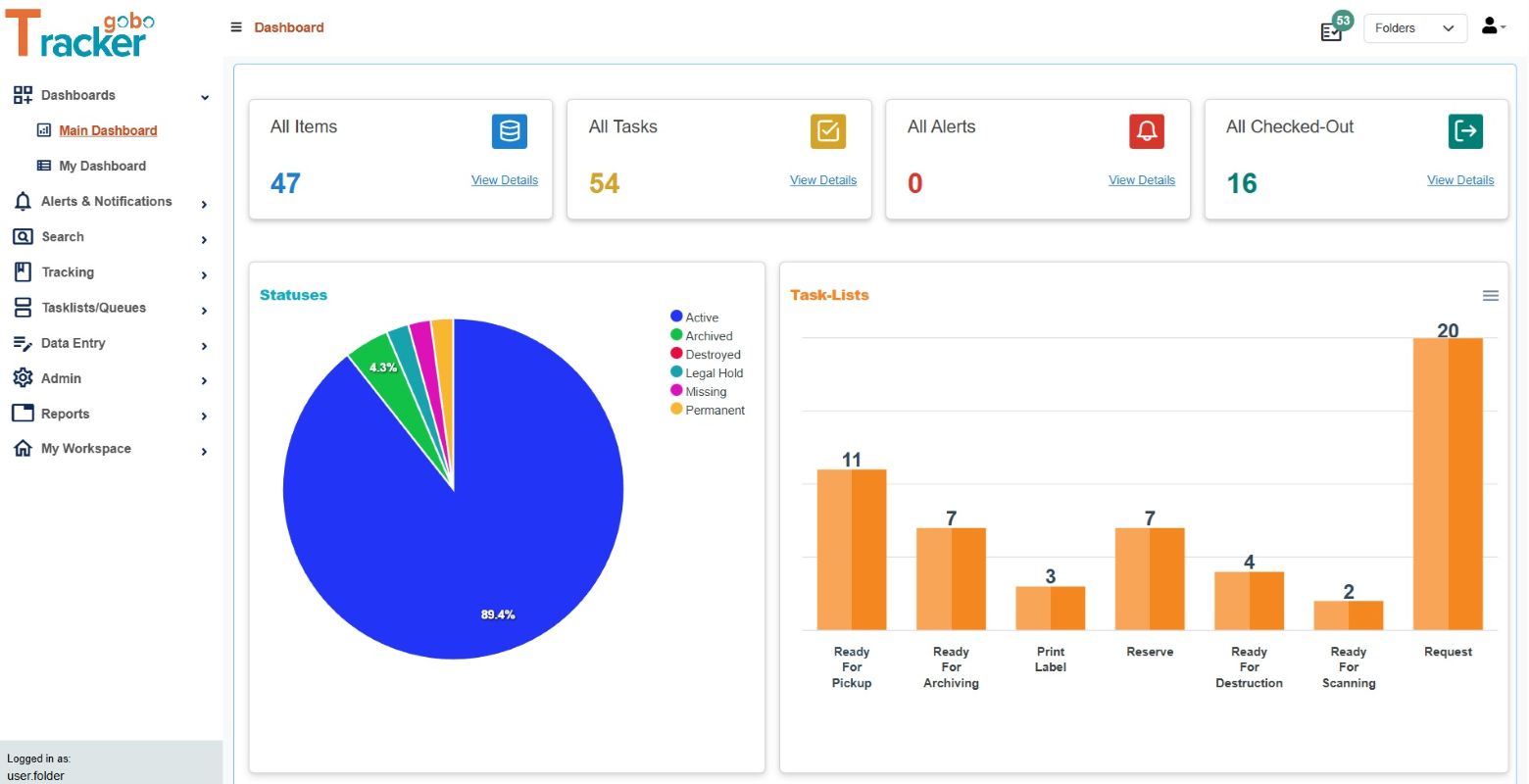
Track files based on their status (e.g., Active, Archived, Destroyed, Legal Hold, Missing etc.).
Check-Out/Check-In Mechanism
Secure process using digital signatures or PIN based authentication.
Quick Check-Out/Check-In
Enabled through RFID portals or windows for rapid file circulation.
Audit Trails & Compliance Reporting
Complete audit trails and compliance reporting for regulatory requirements.
Multi-Location Support
System provides support for multiple locations with centralized management.
Comprehensive Reports
Generate detailed reports for insights and analytics on file movements.
Advanced Dashboards
Real-time dashboards for monitoring file status and operations.
Alerts & Notifications
Delivered via Web, SMS, and Email for timely updates.
Personnel History
Complete history of items issued to personnel with timestamps.
File/Document/Box History
Complete history of activities/actions performed with item.
Dependent Items Checkout
Checkout Boxes & files/documents inside it together in a single transaction.
Mobile RFID Integration
Quick Checkin/Checkout with Mobile/Tablet paired with RFID handheld device.
Kiosk Support
Quick Checkin/Checkout with Wall mounted Kiosk with Barcode technology.
Chain Of Custody Management
Track and maintain complete chain of custody for compliance.
Storage Location Management
Efficient management of storage locations and inventory.
Enterprise Integration
Integration capabilities with existing Document Management Systems via RESTful webservices, file based or Database based integration methods.